Twenty minutes to nine
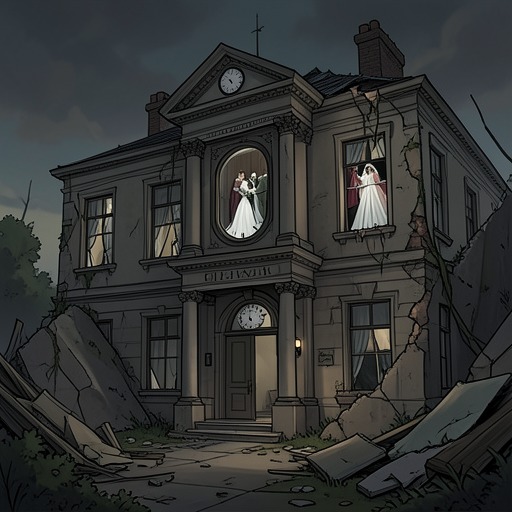
Great ExpectationsTwenty minutes to nine is the fixed time shown by several stopped clocks and a watch at Satis House. Repeated across the house’s rooms and its former brewery grounds, the hour links Miss Havisham’s wedding-time desolation to the estate’s larger atmosphere of decay, making arrested time one of the story’s most persistent visual motifs.
The Time Displayed at Satis House
When Pip first visits, the watch Miss Havisham wears and a clock in her room have both stopped at twenty minutes to nine. The exact time stands out amid Pip’s first impressions of the dark interior: Estella leads him through unlit passages with a candle, while the room’s clocks mark a past that has not moved forward.
The same reading recurs in the outer wall of a detached house in the courtyard, once apparently occupied by the manager or head clerk of the estate’s brewery. The clock there matches Miss Havisham’s watch and room clock. Its position extends the motif beyond the room where she lives: the stopped hour is also inscribed on the grounds and on a building associated with the now-extinct brewery.
A House Suspended in the Past
The fixed time belongs to a broader pattern of enclosure and neglect. Satis House’s front entrance is secured by chains, and its interior passages are dark; in another room, daylight is excluded, dust and mould cover objects, and a feast appears to have been left unfinished when the house and clocks stopped together. The shared hour gives this decay a temporal form: the rooms seem not merely old, but held at the point of an interrupted past.
That impression shapes Pip’s later returns. During one visit, he is to spend the day at the house, walk with Estella through its neglected garden, and wheel Miss Havisham about as in earlier times. The return to familiar places and routines reinforces the contrast between the calendar’s passage and the house’s repeated, seemingly unchanged scenes.
Recurrence and Narrative Meaning
The repeated clock reading is more than a detail of decoration. First seen on the watch and room clock, then found again on the courtyard clock, it gives visible precision to the novel’s motif of arrested time. Its recurrence across different parts of the estate makes the house’s suspended past feel systematic, while the surrounding darkness, abandoned rooms, and neglected grounds supply its physical setting.
The motif also gains force through the contrast between clock time and lived time. Pip grows older and revisits Satis House, but its objects and rituals keep drawing him back into the same atmosphere of expectation and memory. The hour remains fixed even as his understanding of the people and history attached to the house changes.